
The Junior Developer is an Agent: How Local AI is Changing the Org Chart

Table of Contents
Introduction: The Vanishing Entry-Level Rung
It is 2026. The software engineering landscape has stabilized from the chaotic AI gold rush of the early 2020s into something new, pragmatic, and fundamentally different.
Walk into any modern tech company today—from a lean Series B startup to a Fortune 500 enterprise—and ask to see their hiring plan for entry-level developers. You will likely find it empty.
My Hosting Choice
Need Fast Hosting? I Use Hostinger Business
This site runs on the Business Hosting Plan. It handles high traffic, includes NVMe storage, and makes my pages load instantly.
Get Up to 75% Off Hostinger →⚡ 30-Day Money-Back Guarantee
For decades, the “Junior Developer” role was a cornerstone of the industry. It was a mutually beneficial arrangement: companies got affordable labor to handle boilerplate code, write unit tests, and fix low-priority bugs. In return, the junior developer received mentorship, real-world experience, and a path up the career ladder. It was an apprenticeship model that powered the digital explosion.
Today, that model is functionally obsolete.
The bottom rung of the career ladder has not been removed; it has been digitized. The tasks that defined the first two years of a developer’s career—translating a well-defined spec into a function, writing CRUD endpoints, generating test data, refactoring legacy class components into hooks—are no longer human activities. They are compute activities.
We have entered the era of the AI Coding Agent.
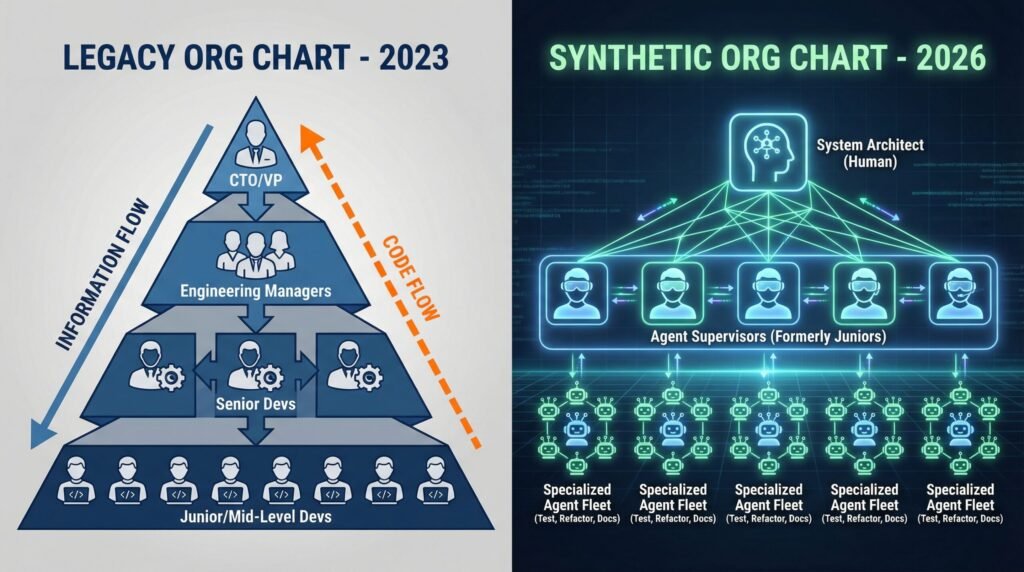
This shift is not merely about productivity tools; it is a restructuring of the engineering org chart. We are moving away from hierarchical teams of humans with varying experience levels toward flat structures of senior human architects managing fleets of autonomous, specialized AI agents.
Crucially, this revolution is not happening in the expensive, privacy-compromised cloud. It is happening on the edge. The new “junior developer” lives on the Neural Processing Unit (NPU) of your standard 16GB laptop, working for free, in total privacy, without ever needing a coffee break.
This is an analysis of the new engineering workforce, the economics driving it, and why the most valuable skill for a human developer in 2026 is no longer writing code, but managing the synthetic intelligence that does.
From Copilot to Colleague: Defining the “Agent”
To understand this shift, we must clarify the terminology. In 2026, the word “AI” has lost much of its meaning through overuse. We need to distinguish between the tools of yesterday and the workforce of today.
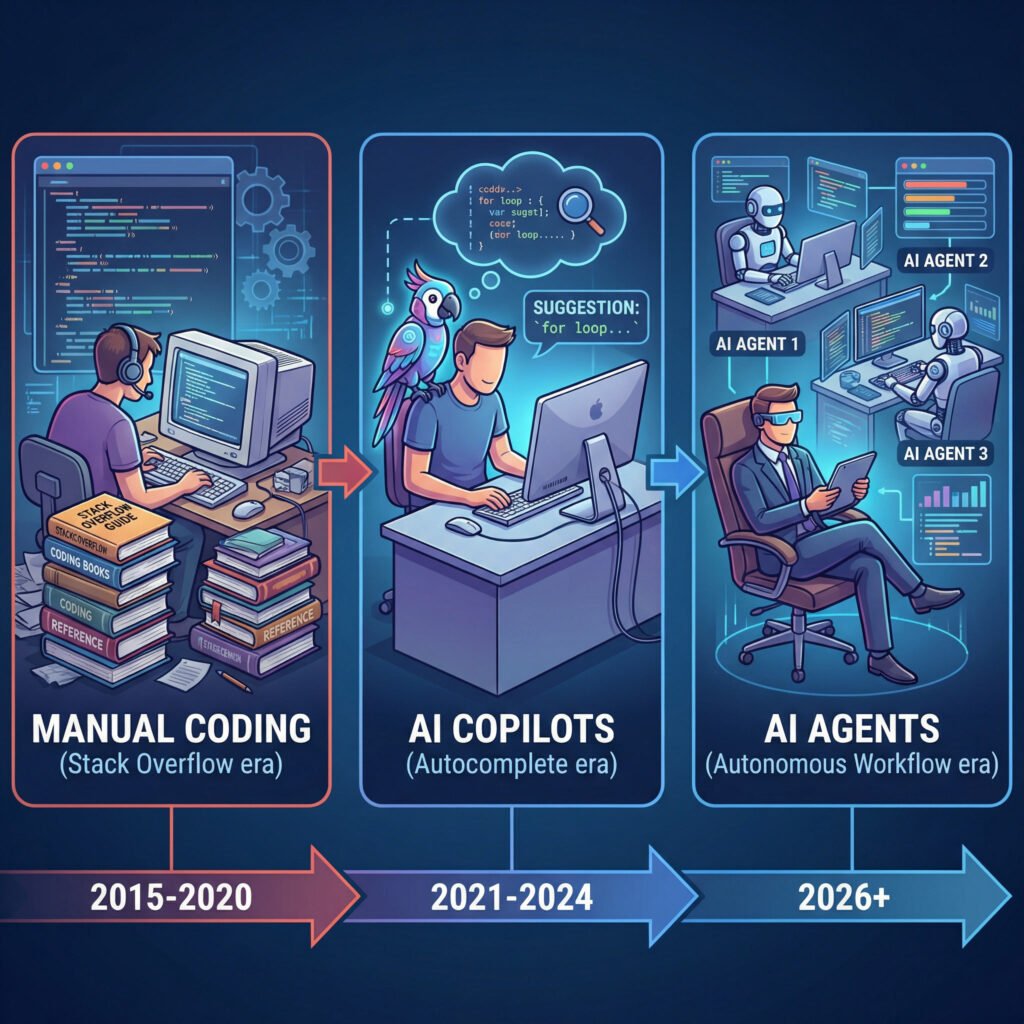
The Era of Assistance (2021–2024)
Tools like GitHub Copilot and Supermaven were the first wave. They were advanced autocomplete engines. They operated on a “loop of seconds.” You typed a comment or a function signature, paused, and the AI suggested the next few lines.
These tools were incredibly valuable—they increased individual developer velocity by 30-50%—but they were fundamentally passive. They waited for human input. If the human stopped typing, the AI stopped working. They were force multipliers for existing engineers, but they could not replace a headcount.
The Era of Agency (2025–Present)
The breakthrough in 2025 was not just smarter models; it was the development of robust Agentic Frameworks.
An “Agent” differs from a “Copilot” in one critical way: Autonomy over time.
You do not give an agent a line of code to complete; you give it a Jira ticket. You assign it a goal, provide it with the repository context and a set of tools (terminal access, file system access, browser access), and you walk away.
An agent operating in 2026 runs on a “loop of hours.” It plans its approach, it writes code, it encounters an error, it reads the stack trace, it Googles the error documentation, it corrects its own code, it writes a test to verify the fix, and finally, it opens a Pull Request and assigns it to a human for review.
The early prototypes of this, like Devin in 2024, were impressive but brittle toys. Today’s open-source agent frameworks, running on optimized Small Language Models (SLMs) like Llama-4-Coder or DeepSeek-V3, are robust enough for production workflows. They possess what early LLMs lacked: persistence and recursive error correction.
When software can read a ticket, modify a codebase, and verify its own work, it is no longer a tool. It is a colleague.
The Economics of the Synthetic Junior
The driving force behind this organizational restructure is, inevitably, economic. The calculus of hiring entry-level human talent has fundamentally broken down against the reality of synthetic labor.
Let us analyze the “Total Cost of Output” for a typical junior-level task: migrating a suite of 50 React components from Javascript to Typescript.
The Human Cost Structure
Hiring a junior developer involves significant overhead beyond salary.
- Recruitment Cost: Months of interviews, recruiter fees, and the time burden on senior staff to conduct technical screenings.
- Onboarding Lag: The 3-6 month period where the new hire is net-negative on team productivity as they learn the codebase and require constant mentorship.
- Operational Overhead: Health insurance, equipment, HR management, sick days, and inevitable attrition.
Even if the junior developer is highly talented, their output is constrained by biological limits. They work 8 hours a day, they get tired, and they make context-switching errors.
The Agent Cost Structure
Now, consider the same task assigned to a fleet of local AI agents in 2026.
- Recruitment Cost: Zero. Spinning up a new agent instance takes seconds.
- Onboarding Lag: Near zero. You feed the agent your repository’s
CONTRIBUTING.md, your style guide, and a few examples of “good” PRs. It has instantly “read” the entire codebase. - Operational Overhead: The cost of electricity to run your laptop’s NPU.
An agent does not get bored refactoring the 49th component. It does not suffer from fatigue at 4:00 PM. It maintains perfect adherence to the style guide on every line. Most importantly, it scales horizontally instantly. If the migration needs to happen faster, you do not need to hire more humans; you simply allocate more local compute to spin up five more agent instances running in parallel.
In 2026, hiring a human to perform repetitive, well-defined coding tasks is viewed by CFOs as financial malpractice.
Useful Links
- Why Developer Communities Are the New Universities in 2025
- Top Low-Code & No-Code Development Platforms for Dev Teams in 2025
- Human Programmer Wins Against OpenAI in Tokyo—What This Means for AI Developers
- 🧠 The 7 AI Coding Mistakes That Are Costing You Time, Money & Rankings (2025 Edition)
- 🌐 The Ultimate Guide to Programmatic SEO for Developers (2025)
- Why Prompt Libraries Are the New Frameworks in AI Coding (2025)
The Critical Role of Local Compute (The 16GB Constraint)
If agents are so powerful, why aren’t companies just running everything through OpenAI’s massive GPT-6 API? Why is the “16GB laptop” relevant to this grand future?
This is the most critical divergence point in the 2026 landscape. The enterprise has realized that autonomous agents cannot exist solely in the cloud.
1. The Privacy Firewall
The defining characteristic of an autonomous agent is that it needs read/write access to your entire codebase. It needs to see your proprietary algorithms, your unpatched security vulnerabilities, and your internal business logic.
In 2026, corporate governance absolutely forbids piping terabytes of sensitive repo data to a third-party API endpoint owned by Microsoft or Google. The risk of IP leakage or supply-chain attacks is unacceptable.
The agent workforce must operate behind the corporate firewall. For the individual developer or small team, that firewall is their laptop.
2. The Economic “Token Tax”
Agents are incredibly chatty. To solve a single Jira ticket, an agent might run an internal monologue loop for hours: thinking, trying code, reading errors, rethinking, retrying. This generates tens of thousands of tokens of input and output.
Running a fleet of agents 24/7 on cloud-based LLMs incurs an unsustainable “token tax.” It is the equivalent of paying a consultant by the word to do your basic labor. It destroys the economic advantage of automation.
3. The Rise of the NPU
The hardware industry anticipated this shift. The laptop you bought in 2026—whether it’s running an Intel Core Ultra, AMD Ryzen AI, or Apple M5 chip—is fundamentally different from computers of the past.
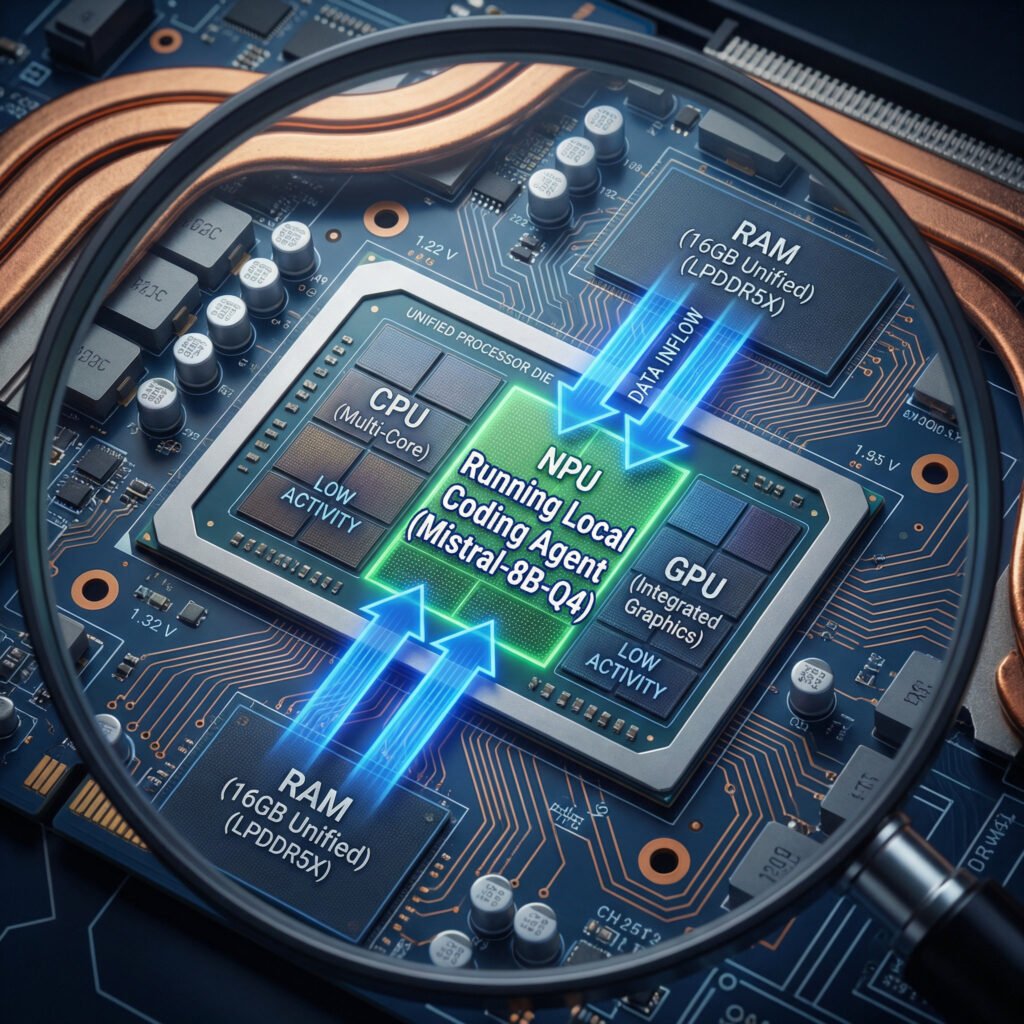
It contains a powerful Neural Processing Unit (NPU). This specialized slice of silicon is designed to do one thing: run quantized Small Language Models (SLMs) efficiently.
An NPU allows a standard 16GB laptop to run a sophisticated 8-billion-parameter coding agent locally, using only a fraction of the power a GPU would require, and leaving the main CPU free for the human’s tasks.
This hardware reality has democratized the agent workforce. You do not need a data center to employ a synthetic team. You just need a decent laptop. The constraint is no longer cloud budget; the constraint is how efficiently you can utilize your local 16GB of RAM to run the smartest possible quantized models.
The New Human Skillset: From Writer to Reviewer
If AI agents are writing the tests, refactoring the legacy code, and scaffolding new features, what is left for the humans? Are we obsolete?
Far from it. The demand for skilled engineers is higher than ever, but the nature of the work has shifted dramatically. We are moving from an era of “Creation” to an era of “Curation” and “Supervision.”
The career path for a new developer in 2026 does not start with writing code; it starts with reading it.
The “Agent Supervisor” (The New Junior)
The entry-level role today is best described as an Agent Supervisor. Their primary responsibility is to manage the output of synthetic workers.
- The Skill: High-velocity code review. An agent might open 20 Pull Requests in a day. The human supervisor needs the skill to quickly scan generated code, identify subtle logic flaws that pass unit tests, detect security hallucinations, and ensure architectural consistency.
- The Prompt Engineering: When an agent gets stuck in a loop or produces garbage, the supervisor must know how to “debug” the agent’s instructions. This involves tweaking the system prompt, providing better context examples, or switching the agent to a different underlying model.
- The Gatekeeper: Agents are enthusiastic but naive. They will happily import a malicious package if it solves their immediate problem. The human supervisor is the crucial security barrier, approving every external dependency and architectural decision.
The System Architect (The New Senior)
For senior engineers, the job has become almost entirely focused on high-level design and complex problem-solving.
- System Design: Agents are terrible at big-picture thinking. They cannot design a microservices architecture that balances consistency and availability across global regions. This remains a uniquely human task.
- Translating Ambiguity: The most valuable skill is taking a vague business requirement from a Product Manager—”We need to improve user retention on the dashboard”—and translating that into the precise, atomic series of technical tasks that agents can execute.
- Taste: Perhaps the most undefinable human skill is “taste.” Knowing what feels like elegant, maintainable code versus code that just happens to pass the tests. Humans set the aesthetic and architectural standards that the agents must follow.
Conclusion: Adapt or Manage Legacy
The industrial revolution didn’t eliminate the need for labor; it shifted labor from artisans weaving textiles by hand to engineers designing and maintaining power looms.
The AI revolution in software engineering is no different. The “hand-weaving” era of coding—manually typing out boilerplate, hunting for missing semicolons, writing repetitive unit tests—is drawing to a close.
The junior developer role, as we knew it, is gone. It is not coming back. The economics of synthetic labor are too compelling, and the capabilities of local hardware have made it accessible to everyone.
For the aspiring engineer in 2026, this is not a door closing; it is an elevator opening. You no longer need to spend the first two years of your career doing grunt work. You can immediately step into a role of management, architecture, and high-level problem solving.
Your value is no longer defined by how many lines of code you can type into an editor. Your value is defined by how effectively you can orchestrate a fleet of silicon intelligence on your 16GB machine to build things faster, better, and vastly larger than you ever could alone.
Welcome to management. Your team is ready to work.

🚀 Let's Build Something Amazing Together
Hi, I'm Abdul Rehman Khan, founder of Dev Tech Insights & Dark Tech Insights. I specialize in turning ideas into fast, scalable, and modern web solutions. From startups to enterprises, I've helped teams launch products that grow.
- ⚡ Frontend Development (HTML, CSS, JavaScript)
- 📱 MVP Development (from idea to launch)
- 📱 Mobile & Web Apps (React, Next.js, Node.js)
- 📊 Streamlit Dashboards & AI Tools
- 🔍 SEO & Web Performance Optimization
- 🛠️ Custom WordPress & Plugin Development