
Beyond the Chatbot: Why 2026 is the Year of Agentic AI

Table of Contents
We have all been there. You paste a complex error log into ChatGPT or Claude, and it gives you a brilliant solution. But then… you have to implement it. You have to open your terminal, type the commands, fix the new errors that pop up, and paste the results back into the chat.
The AI is the brain, but you are still the hands.
My Hosting Choice
Need Fast Hosting? I Use Hostinger Business
This site runs on the Business Hosting Plan. It handles high traffic, includes NVMe storage, and makes my pages load instantly.
Get Up to 75% Off Hostinger →⚡ 30-Day Money-Back Guarantee
In 2024 and 2025, we marveled at Generative AI—machines that could write poetry, generate images, and explain quantum physics. But as we look toward 2026, the tech industry is pivoting hard to a new paradigm: Agentic AI.
If Generative AI is a “Thinker,” Agentic AI is a “Doer.” It doesn’t just suggest code; it opens the file, writes the patch, runs the test suite, and pushes to GitHub—all while you grab a coffee.
In this deep dive for Dev Tech Insights, we will explore why Agentic AI is the defining trend of 2026, the software architecture behind it, and how you can start building your own workforce of digital agents today.
1. What is Agentic AI? (And How is it Different?)
To understand Agentic AI, we must first distinguish it from the “Passive AI” (Chatbots) we have used for the last few years.
The Passive AI (Chatbot) Model
- Input: User Prompt (“How do I fix this Python bug?”)
- Process: Pattern Matching & Next-Token Prediction.
- Output: Textual Advice.
- Limitation: It has no agency. It cannot affect the real world. It relies on the human user to execute its advice.
The Agentic AI Model
- Input: High-Level Goal (“Fix the Python bug in
main.pyand deploy the app.”) - Process:
- Planning: The AI breaks the goal into sub-tasks.
- Tool Use: The AI calls a “File Read” tool to inspect the code.
- Action: It uses a “Terminal” tool to run the script and see the error.
- Iteration: It rewrites the code, runs the test again, and self-corrects if it fails.
- Output: A completed task (e.g., a merged Pull Request).
Key Takeaway: Chatbots talk. Agents act.
In 2026, the metric for AI success is shifting from “How realistic is the text?” to “What is the success rate of the task?” This shift is driving the rise of Large Action Models (LAMs), which are fine-tuned not just on language, but on API calls, function execution, and software interaction.
| Feature | Standard Chatbot (2024) | Agentic AI (2026) |
| Primary Goal | Conversation & Information | Task Execution & Results |
| Capability | Can generate text/code | Can run code, browse web, save files |
| Interaction | Passive (Waits for prompt) | Active (Loops until goal is met) |
| Memory | Limited to chat window | Connected to Vector DBs / File System |
| Example | ChatGPT, Claude | AutoGen, Devin, CrewAI |
2. The Architecture of an Agent: Anatomy of a Digital Worker
If you are a developer looking to build an agent, you can’t just rely on prediction. You need a system architecture. A standard Agentic AI consists of four main pillars:
A. The Brain (The LLM)
This is still the core (e.g., GPT-4o, Claude 3.5 Sonnet, or open-source models like Llama 3). However, in an agentic system, the LLM isn’t the whole product; it’s just the reasoning engine. It decides what to do next based on the current state.
B. The Tools (The Hands)
An agent is useless without tools. Tools are simply executable functions that the LLM can “call.”
- Web Search: To find documentation or real-time data.
- Code Interpreter: A sandbox (like Python REPL) to run code safely.
- File System Access: To read/write logs and config files.
- API Connectors: To interact with Slack, Jira, GitHub, or AWS.
C. The Planning Module (The Strategy)
This is where the magic happens. Before acting, the agent creates a plan.
- Chain of Thought (CoT): “First I will read the file, then I will try to replicate the bug.”
- ReAct (Reason + Act): A loop where the model reasons about a situation, acts, observes the output, and reasons again.
- Reflection: Advanced agents in 2026 execute a task, critique their own work (“Wait, this code introduces a security vulnerability”), and fix it before showing it to the human.
D. Memory (The Context)
Chatbots suffer from context limits. Agents rely on:
- Short-term Memory: The current chat logs and terminal outputs.
- Long-term Memory (Vector DBs): Storing past solutions, documentation, and user preferences in a vector database (like Pinecone or Milvus) so the agent doesn’t make the same mistake twice.
3. The Tech Stack: How to Build Agents in 2026
For developers, the exciting part is the tooling. We are moving away from simple API wrappers to complex orchestration frameworks.
Here is a simple example using Python and LangChain. This agent doesn’t just chat; it uses the ‘SerpApi’ tool to search Google for real-time information and then uses a ‘Calculator’ tool to process the numbers—something a standard LLM often gets wrong.
from langchain.agents import load_tools, initialize_agent, AgentType
from langchain.chat_models import ChatOpenAI

# 1. The Brain: Initialize the Language Model
llm = ChatOpenAI(temperature=0, model="gpt-4")

# 2. The Tools: Give the agent abilities (Search and Calculate)
# 'serpapi' allows it to search Google; 'llm-math' allows it to do math.
tools = load_tools(["serpapi", "llm-math"], llm=llm)

# 3. The Agent: Initialize the agent with the tools and the brain
agent = initialize_agent(
    tools,
    llm,
    agent=AgentType.ZERO_SHOT_REACT_DESCRIPTION,
    verbose=True # This lets you see the agent's "thought process" in the console
)

# 4. The Action: Give the agent a complex goal
agent.run("Who is the current CEO of Twitter, and what is their age raised to the power of 0.5?")
Notice the verbose=True flag? That’s the key. When you run this, you won’t just get an answer. You will see the agent thinking: ‘First I need to search for the CEO, then I need to find their age, then I need to calculate the power.’ It loops until it finishes the task.
LangChain & LangGraph
LangChain was the pioneer, but LangGraph is the future for 2026. While LangChain is great for linear chains (Input → A → B → Output), LangGraph allows for cyclical, stateful flows. This is essential for agents that need to loop: Try → Fail → Analyze → Retry.
Microsoft AutoGen
If you want to build a team of agents, AutoGen is the industry standard. It allows you to spawn multiple agents with different personas:
- Agent A (Coder): Writes the Python script.
- Agent B (Reviewer): Critiques the code for bugs.
- Agent C (User Proxy): Executes the code and reports errors back to Agent A. These agents “chat” with each other to solve the problem, often achieving better results than a single monolithic model.
CrewAI
CrewAI is gaining massive traction for its simplicity. It treats agents like employees. You assign them a “Role” (e.g., Senior Analyst), a “Goal” (e.g., Summarize this market data), and a “Backstory.” It excels at role-playing based orchestration.
The “Open Weight” Revolution
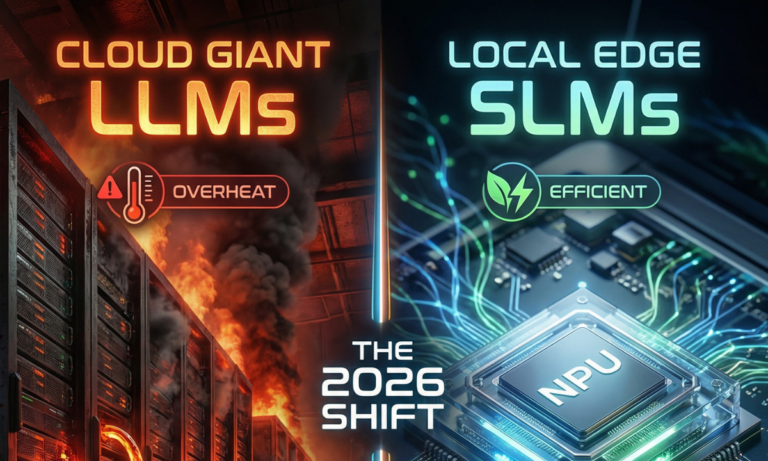
In 2026, we are seeing more agents running on local hardware using quantized versions of Llama or Mistral. Why? Privacy and Cost. An agent running in a loop might make 1,000 API calls to solve one bug. Doing that on GPT-4 is expensive; doing it on a local Llama 3 model is free.
Useful Links
- The Era of Small Language Models (SLMs): Why 2026 Belongs to Edge AI
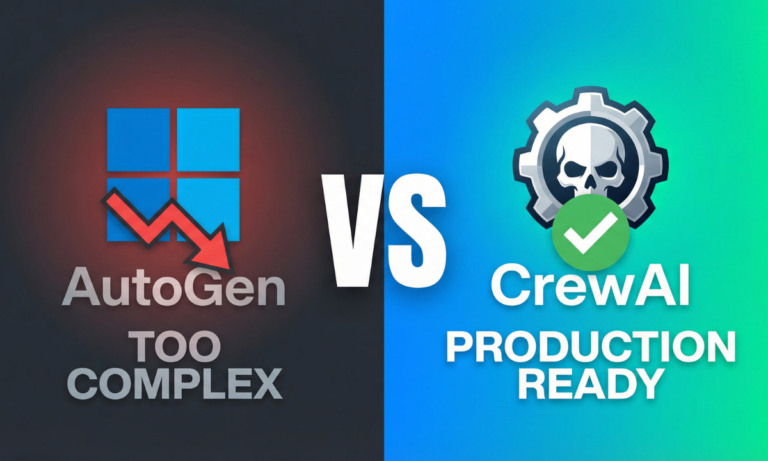
- Microsoft AutoGen vs. CrewAI: I Ran a “Code Battle” to See Who Wins in 2026
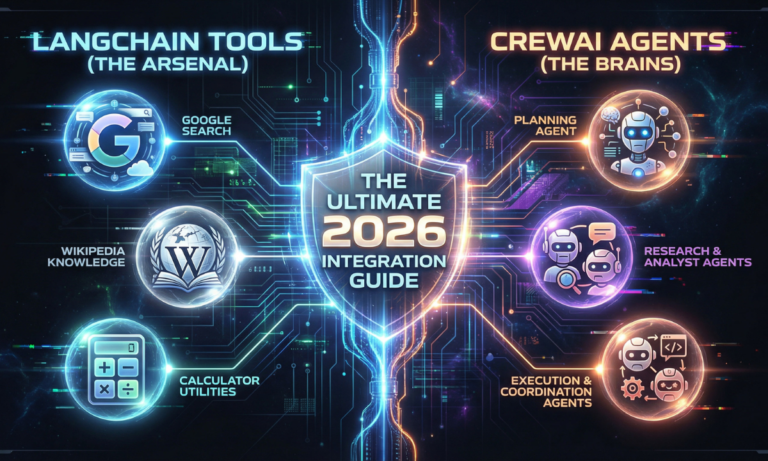
- How to Build AI Agents with LangChain and CrewAI (The Complete 2026 Guide)
- Why Developers Are Moving from ChatGPT to Local LLMs (2025)
- LangChain vs. LlamaIndex (2026): Which AI Framework Should You Choose?
- Toil is Back: Why Even with AI, SREs Feel the Burn in 2025
4. Real-World Use Cases: Where Agents Are Winning
Where is this actually being used? It’s not just for writing code.
1. The “Junior Developer” Agent
Companies are deploying agents that sit in the GitHub repository. When an issue is tagged “easy fix,” the agent clones the repo, reproduces the bug, writes a test case, fixes the code, and opens a Pull Request. The human senior dev only needs to review and merge.
2. Autonomous Security Operations (SecOps)
In cybersecurity, speed is everything. Agentic AI monitors logs 24/7. When it detects an anomaly (like an unknown IP accessing a database), it doesn’t just send an alert. It actively investigates: checks the IP reputation, queries the firewall logs, and even temporarily isolates the compromised server—all before the human analyst wakes up.
3. “Search Everywhere” Marketing Agents
Marketing teams are using agents to browse the web autonomously. A “Competitor Analysis Agent” can visit 50 competitor websites every morning, take screenshots, summarize pricing changes, and update a shared Excel sheet with the day’s market movements.
5. The Challenges: Why We Aren’t There Yet
Despite the hype, Agentic AI in 2026 still faces significant hurdles that developers must navigate.
The “Infinite Loop” Problem
Agents can get stuck. If an agent tries to fix a bug, fails, and tries the exact same fix again, it enters an infinite loop of failure. Building “guardrails” (forcing the agent to stop or ask for help after 5 failures) is a critical part of agent engineering.
Cost & Latency
Agentic workflows are slow. A single request might trigger 50 internal steps. For a user waiting for a response, 30 seconds of “thinking” feels like an eternity.
Security Risks (Prompt Injection)
If you give an AI agent access to your terminal or your email, you are creating a massive attack vector. “Prompt Injection” attacks—where a hacker tricks the AI into executing malicious commands—are a major concern. Zero Trust architecture for AI agents is becoming a mandatory field of study.
6. Conclusion: The Future is “Managerial”
The rise of Agentic AI changes what it means to be a developer. In 2020, we wrote code. In 2024, we prompted AI to write code. In 2026, we manage AI agents that write code.
Your job title might not change, but your day-to-day work will shift from “syntax generation” to “system architecture.” You will become the architect of a digital workforce, defining the goals, constraints, and tools for your agents.
The developers who embrace this—who learn to build, orchestrate, and debug agents—will be the tech leaders of this decade.
Are you ready to build your first agent?
Related Links
Frequently Asked Questions (FAQs)
1. What is the main difference between a Chatbot and an AI Agent?
A chatbot is passive; it provides text-based answers and relies on the user to take action. An AI Agent is active; it uses “tools” (like web browsers, terminals, or APIs) to execute tasks, solve problems, and achieve goals autonomously without constant human intervention.
2. Which framework is best for building AI agents in 2026?
It depends on your goal. LangChain/LangGraph is best for developers who want granular control over the agent’s logic and state. Microsoft AutoGen is superior for multi-agent collaboration (agents talking to agents). CrewAI is excellent for beginners who want to set up role-based agent teams quickly.
3. Can AI Agents run locally without internet?
Yes. By using “Open Weight” models like Llama 3 or Mistral running on tools like Ollama or LM Studio, you can build fully private, local agents. However, their reasoning capabilities may be lower than massive cloud models like GPT-4o.
4. Are AI Agents safe to use with my personal data?
Agents carry more risk than chatbots because they can act. If an agent has permission to delete files or send emails, a bug could cause data loss. It is crucial to implement “Human-in-the-Loop” (HITL) approval steps for sensitive actions.
5. Will AI Agents replace software developers?
Not exactly. They will replace the routine parts of coding (boilerplate, testing, bug fixing). However, developers will still be needed to design the system architecture, define the agents’ goals, and review the complex logic. The role will shift from “Coder” to “AI Systems Architect.”

🚀 Let's Build Something Amazing Together
Hi, I'm Abdul Rehman Khan, founder of Dev Tech Insights & Dark Tech Insights. I specialize in turning ideas into fast, scalable, and modern web solutions. From startups to enterprises, I've helped teams launch products that grow.
- ⚡ Frontend Development (HTML, CSS, JavaScript)
- 📱 MVP Development (from idea to launch)
- 📱 Mobile & Web Apps (React, Next.js, Node.js)
- 📊 Streamlit Dashboards & AI Tools
- 🔍 SEO & Web Performance Optimization
- 🛠️ Custom WordPress & Plugin Development