Software Development Life Cycle (SDLC) in 2025: Stages, Models, and Modern Practices

Table of Contents
Introduction
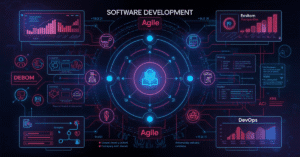
SDLC — the Software Development Life Cycle — has been the backbone of software engineering for decades. It’s the map teams use to go from idea to production and then keep code healthy in the wild. In 2025, SDLC isn’t dead; it’s evolving. Agile and DevOps have reshaped how we think about iterations and releases, AI tooling is speeding up mundane tasks, and remote/hybrid teams have forced process changes that actually stick.
But the core question remains the same: how do you reliably ship software that matters? This article walks the SDLC path in 2025 with practical advice, developer voices from the trenches, and a few honest warnings from my own experience.
My Hosting Choice
Need Fast Hosting? I Use Hostinger Business
This site runs on the Business Hosting Plan. It handles high traffic, includes NVMe storage, and makes my pages load instantly.
Get Up to 75% Off Hostinger →⚡ 30-Day Money-Back Guarantee
What is SDLC? A practical definition
Put simply, SDLC is the end-to-end process for building software: from understanding customer problems, to designing solutions, writing code, testing it, deploying to production, and maintaining it. It’s not a single methodology — it’s a framework of stages, and teams pick models (Waterfall, Agile, DevOps-first, hybrid) to sequence those stages.
In a modern context, SDLC includes the social/organizational layers: how teams talk (not just who writes code), how CI/CD is structured, and how production telemetry feeds back into planning. In 2025, the life cycle is as much about feedback loops as it is about discrete stages.
Classic SDLC stages (and what they mean today)
I’ll list the canonical stages, then call out how each looks in modern practice.
- Planning & Requirements
- Classic: Gather requirements, produce specs.
- 2025: Continuous discovery — product, research, and engineering collaborate in short loops. Requirements are hypothesis-driven and validated with prototypes, analytics, and quick user sessions.
- Analysis
- Classic: Feasibility, architecture sketching.
- 2025: Rapid feasibility checks using proof-of-concepts, cloud sandboxes, and AI-assisted spike prototypes (e.g., “create a minimal working integration with Stripe/Algolia”).
- Design
- Classic: System + UI/UX design documents.
- 2025: Design systems, component libraries, and accessible-first patterns. Designers and engineers share component-driven repos; design tokens are part of the codebase.
- Development (Implementation)
- Classic: Coding, local builds.
- 2025: Cloud dev environments (Codespaces/Gitpod), feature-flagged branches, pair programming with AI copilots for boilerplate and tests. Developers focus more on business logic and less on repetitive code.
- Testing
- Classic: QA, unit tests, integration tests.
- 2025: Shift-left + automation: unit tests, contract tests, E2E in CI, canary releases, synthetic monitoring. AI-generated tests help cover boilerplate scenarios faster — but human tests still guard complex flows.
- Deployment
- Classic: Release cycles (monthly/quarterly).
- 2025: Continuous deployment pipelines, infrastructure-as-code, blue/green or canary strategies. Rollbacks are automated and tested.
- Maintenance & Monitoring
- Classic: Bugfixes and patches.
- 2025: Observability-first: logs + traces + metrics + SLOs. Error budgets and incident retros fuel backlog prioritization.
- Feedback & Iteration
- Classic: Periodic review and planning.
- 2025: Feedback is real-time (user telemetry, session replays, support tickets) and immediately closes the loop into planning and backlog grooming.
If you want more details with enhanced visuals, then download the pdf below(login required):
Download PDF!SDLC models explained (and when to pick each)
There’s no one right model; you pick depending on product type, team maturity, regulation, and risk appetite.
Waterfall
- What it is: Linear, stage-by-stage execution.
- When to use: Regulated industries (medical devices, certain defense contracts), projects with fixed, well-defined scope and little expected change.
- 2025 note: Rare for greenfield web apps — still relevant for compliance-heavy systems.
Iterative / Incremental
- What it is: Repeated cycles that expand functionality.
- When to use: Projects that benefit from staged delivery; useful when core design needs validation across iterations.
Agile (Scrum / Kanban)
- What it is: Short iterations, continuous feedback, cross-functional teams.
- When to use: Most modern product teams. Great for products that must evolve with user feedback.
- 2025 note: Agile combined with strong engineering practices (CI/CD, automation) is the de facto for consumer and SaaS apps.
DevOps & Continuous Delivery (CD)
- What it is: Focuses on automation, culture change, and merging dev + ops responsibilities.
- When to use: Where fast, reliable delivery to production is required; especially effective when paired with SRE practices.
- 2025 note: For many teams, DevOps is not a model but an operating principle embedded into SDLC.
Hybrid Models (Composable SDLC)
- Combine regulatory/regimented stages with iterative delivery. For example, maintain strict documentation and formal verification for compliance-critical subsystems while shipping user-facing features iteratively.
Plan
Discovery & goals
→
Design
Architecture & UX
→
Build
Dev & unit tests
→
Test
Automation & QA
→
Deploy
CI/CD release
→
Monitor
Observability & SLOs
How AI, automation, and tools are reshaping SDLC in 2025
AI tooling has advanced from autocomplete into higher-impact areas:
- AI-assisted requirements & docs: Drafting requirement summaries, acceptance criteria, and even generating initial API contracts based on plain English prompts.
- Code generation & scaffolding: Copilots create skeletons and tests. This speeds initial development but requires human supervision for architecture and security.
- Auto-testing & fuzzing: Tools generate regression tests and property checks, covering edge cases quickly.
- CI/CD optimization: Pipelines can detect which tests to run based on changed code, reducing feedback time.
- Monitoring & noise reduction: AI helps triage alerts, group similar incidents, and propose probable root causes.
But: AI is a force multiplier, not a replacement. Experienced engineers still provide architecture, security judgement, and complex system design.
Developer & community perspectives (real-world voices)
Across developer forums in 2023–2025, a few themes keep resurfacing. I synthesized the prevailing opinions so you get a panoramic view:
Useful Links
- Forget Selenium: Building AI Agents with browser-use & DeepSeek (The New 2026 Standard)
- Is Bun Ready to Replace Node.js in Production? A 2025 Developer’s Take
- The Rise of Composable Software: Why Developers Need to Think Modular in 2025
- Toil is Back: Why Even with AI, SREs Feel the Burn in 2025
- Best Python Libraries for Automation Developers Overlook in 2026
- Functional Programming in 2025: Are Pure Functions Making a Comeback?
- On Agile vs. Reality: Many developers praise Agile for flexibility but complain teams often apply rituals without the outcomes — “we do standups and sprints but still ship in large batches.” (Common sentiment on Reddit threads in r/devops and r/programming.)
- On DevOps maturity: Engineers say “DevOps isn’t tools; it’s ownership.” Teams with true end-to-end ownership ship higher quality code faster. One recurring note: companies who treat SRE as a first-class discipline see the best uptime and lower operational toil.
- On AI assistance: Frontend and backend devs love how copilots scaffold code, but senior devs caution against blindly accepting generated code without review — security and design errors creep in.
- On process fatigue: A consistent criticism: too many meetings and heavy ceremony hinder focus. The most productive engineering cultures I’ve seen enforce “no meeting” blocks to let deep work happen.
- On documentation & knowledge sharing: Devs argue that living documentation (code + tests + observability) beats stale docs. Teams that keep docs close to code (docs-as-code) win on onboarding and maintenance.
Those voices are echoed in interview snippets, conference panels, and community postings — they’re not abstract; they reflect how teams operate daily.
My perspective — what works (and what I’ve learned)
I’ve led engineering teams that migrated from waterfall-ish cycles into a DevOps/Agi le blend. A few practical lessons:
- Instrument first, then optimize. Before you rewrite architecture to chase performance, get observability in place. You’ll learn where the real pain points are.
- Automate the boring reliably. CI, linting, security scanning, dependency updates — automate these and free humans for creative work.
- Invest in API contracts and contract tests. When services communicate, contract tests prevent a lot of integration pain later.
- Feature flags are your friend. They let you release safely and test in production with guardrails.
- Limit scope creep with hypothesis-driven work. Treat features as experiments: define the metric, run the experiment, act on the data.
Also: be ruthless about reducing coordination friction. Aligning cross-functional squads around outcomes (not tasks) makes SDLC more meaningful.
Common SDLC mistakes I still see in 2025
- Pretending tools fix culture. You can buy observability and CI tools, but without ownership they’re underused.
- Testing as an afterthought. When QA is the last gate, late-stage surprises happen. Shift-left testing and test automation are non-negotiable.
- Monolith-by-accident. Teams calling something “microservices” but keeping a tightly coupled database produce brittle systems.
- No rollback plan. Releases need tested rollbacks and clear incident playbooks — not just optimistic deploy scripts.
- Measurement vacuum. If you can’t measure the user-facing impact of a change, you’re shipping for vanity.
Practical checklist: picking the right SDLC model in 2025
Use this to guide decisions quickly:
- Small app / single client: Lightweight iterative model; focus on speed and developer experience.
- Regulated domain (health/finance): Hybrid Waterfall + DevOps — formal verification where needed, iterative elsewhere.
- Large multi-product organization: Team-per-product approach, DevOps + SRE, strong API contracts, and composable architecture.
- Rapid experimentation (startups): Lean Agile — prototype fast, validate with users, iterate or pivot.
- When uncertain: Start with a small pilot using DevOps practices and measure the velocity + production quality. Scale from there.
| Model | When to Use | Pros | Cons |
|---|---|---|---|
| Waterfall | Compliance-heavy projects, fixed scope | Predictable phases, clear documentation | Rigid; hard to adapt to change |
| Iterative / Incremental | Projects needing staged delivery | Faster feedback, risk mitigation | Needs discipline to prevent scope creep |
| Agile (Scrum/Kanban) | Most product teams, user-driven development | Fast feedback, cross-functional teams | Can be misapplied; rituals without outcomes |
| DevOps / CD | Teams aiming for reliable, frequent releases | Automation, reliability, faster MTTR | Requires investment in automation and culture |
| Hybrid / Composable | Large orgs, mixed regulatory needs | Best-of-both-worlds, flexible governance | Complex governance; needs strong ownership |
Tip: choose the model that minimizes coordination friction for your org size and risk profile.
Metrics & SLOs: how to measure SDLC health
Pick a few meaningful indicators (don’t overload):
- Lead time for changes — time from commit to production.
- Deployment frequency — how often you ship.
- Change failure rate — % of releases causing incidents.
- Mean time to recovery (MTTR) — how quickly you fix production issues.
- Cycle time — time from work start to completion.
- User-facing metrics — conversion, engagement, latency (most important: correlate engineering metrics with product outcomes).
SRE-style SLOs help balance innovation vs reliability. Treat error budgets like a currency teams spend for experiments.
Team & culture: process beats tools
The most advanced toolchain won’t help a team that lacks autonomy, psychological safety, or clear ownership. Encourage:
- Blameless postmortems
- Clear code ownership
- Cross-functional teams with aligned goals
- Focused deep-work time for engineers
- Lightweight governance — enough to prevent chaos, not so much that it chokes velocity
Final thoughts — the SDLC you choose should be practical
SDLC in 2025 is less about picking the perfect named model and more about assembling practices that fit your org and product. Instrument your systems early, automate relentlessly, and keep feedback loops short. Use AI and cloud environments to speed repetitive parts — but protect human-led judgment where it matters: security, architecture, and product decisions.
If you treat SDLC as a living system — measured, adjusted, and respected by the whole org — you’ll ship better software and keep your team sane.
FAQs
1. What SDLC model should startups use in 2025?
Startups should favor lean, iterative models with CI/CD and feature flags. Ship fast, measure, and pivot. Heavy formal processes can be introduced later as you scale.
2. How has DevOps changed SDLC?
DevOps integrated operations into the lifecycle by promoting automation, ownership, and continuous feedback. It turns discrete release events into ongoing delivery and closes the loop with monitoring and incident learning.
3. Can AI replace QA engineers?
No. AI automates test generation and regression coverage but complex exploratory testing, security reasoning, and cross-cutting architecture validation still need human expertise.
4. What are the first five automation steps teams should invest in?
1) Continuous integration (automated builds)
2) Linting & static analysis
3) Automated unit & contract tests
4) Security scanning (SAST/DAST)
5) Automated deployments with rollbacks.
5. How do you manage SDLC in a regulated industry?
Use a hybrid model: formal documentation and verification for regulated subsystems + iterative release for user-facing components. Ensure traceability, audit logs, and documented test evidence.

🚀 Let's Build Something Amazing Together
Hi, I'm Abdul Rehman Khan, founder of Dev Tech Insights & Dark Tech Insights. I specialize in turning ideas into fast, scalable, and modern web solutions. From startups to enterprises, I've helped teams launch products that grow.
- ⚡ Frontend Development (HTML, CSS, JavaScript)
- 📱 MVP Development (from idea to launch)
- 📱 Mobile & Web Apps (React, Next.js, Node.js)
- 📊 Streamlit Dashboards & AI Tools
- 🔍 SEO & Web Performance Optimization
- 🛠️ Custom WordPress & Plugin Development